



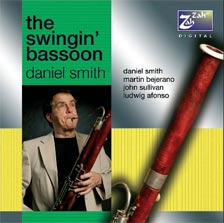
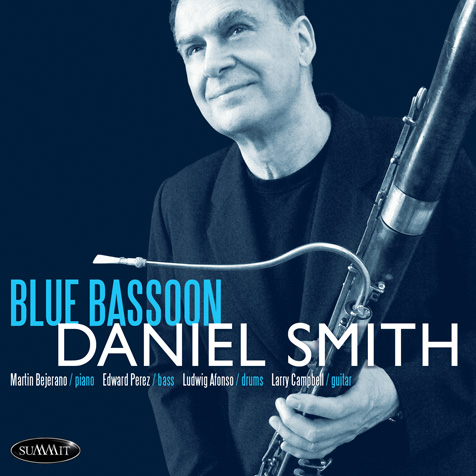

As far as I know, the best jazz
performance ever by a bassoon player. Daniel Smith is a
classical virtuoso who knows how to swing and improvise
superbly in a jazz context. Recorded on October 29 & 30,
2008, at Skyline Studios, NY, "Blue Bassoon" was
produced by Robert Smith. Smith plays his ass off,
backed by Martin Bejerano (piano), Edward Perez (bass)
and Ludwig Afonso (drums). Guitarist Larry Campbell
guests on two tracks.
The repertoire goes from Robert Johnson ("From Four Till
Late") to Joe Zawinul ("Scotch and Water"). The "Charlie
Parker of the bassoon" also flies high on themes by
Horace Silver ("The Jody Grind"), Lee Morgan ("The
Double Up"), Charles Mingus ("Nostalgia in Times
Square"), Wayne Shorter ("Footprints"), John Coltrane
("Equinox"), Cannonball Adderley ("Sack O' Woe"), George
Shearing ("Break Out The Blues") and, of course, Parker
("Billie's Bounce").
Hear samples
from
'Blue Bassoon'
Daniel Smith
Virtuoso Bassoonist
Classical, Jazz & Crossover Artist
2000/11
UK Tour!
Promotional
Information for
Concert Halls, Theatres,
Jazz Festivals Jazz & Music Clubs
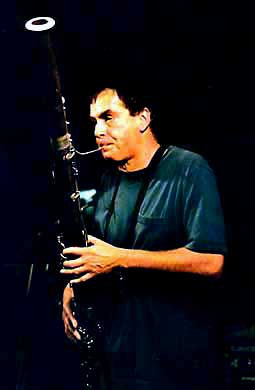 Daniel
Smith The leading pioneer
of the bassoon with his many critically acclaimed award-winning
recordings and live performances. As the most recorded bassoon
soloist in the world, his repertoire spans music ranging from
Baroque concerti to contemporary music including jazz, ragtime and
crossover. He is the only bassoonist performing and recording in
both the jazz and classical fields. Daniel Smith's unique career has
been profiled in Gramophone, the New York Times, Fanfare, Classical
Music, Musical Heritage Review, American Record Guide, Classic CD
and many leading European publications including The Times in
England. In the USA, his career was highlighted on PBS's "All Things
Considered'. In the UK, one of his recordings was the 'signature
tune' for BBC Radio 3 while BBC Radio 4 recently showcased his
career.
Daniel
Smith The leading pioneer
of the bassoon with his many critically acclaimed award-winning
recordings and live performances. As the most recorded bassoon
soloist in the world, his repertoire spans music ranging from
Baroque concerti to contemporary music including jazz, ragtime and
crossover. He is the only bassoonist performing and recording in
both the jazz and classical fields. Daniel Smith's unique career has
been profiled in Gramophone, the New York Times, Fanfare, Classical
Music, Musical Heritage Review, American Record Guide, Classic CD
and many leading European publications including The Times in
England. In the USA, his career was highlighted on PBS's "All Things
Considered'. In the UK, one of his recordings was the 'signature
tune' for BBC Radio 3 while BBC Radio 4 recently showcased his
career.
Daniel Smith's performances include jazz with his quartet 'Bassoon
and Beyond', classical recitals with piano, concertos with
orchestra, and highly popular programs divided between classical and
jazz, with music ranging from Vivaldi, Elgar, Mozart and Verdi to
Duke Ellington, John Coltrane, Charlie Parker, Sonny Rollins and
Dizzy Gillespie. Described as a 'phenomenon', he has been called the
'Gerry Mulligan of the Bassoon' in the world of jazz and the
'Galway' and 'Rampal of the Bassoon' in the world of classical
music, bringing his unique sound and style to concert series,
Festivals, Theatres and Jazz or Music Clubs.
Pod3tv, the award winning commercially sponsored video podcast production company with over four million viewers, showcases the extraordinary artistry of the acclaimed bassoon virtuoso Daniel Smith. http://www.pod3.tv/node/633
Daniel Smith is No.12 on the
Top 200 Jazz Profiles Viewed on allaboutjazz
http://www.allaboutjazz.com/php/musician_hitcount.php
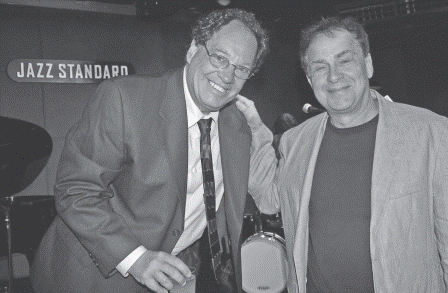 DANIEL SMITH
AS FINALIST!
DANIEL SMITH
AS FINALIST!
Daniel Smith was nominated as one of five finalists for the 2010 Jazz
Journalists Association Jazz Award in the category of: Player of the Year of
Instruments Rare in Jazz.
As the first bassoonist to be so honoured in the 12 year history of the Jazz Journalists Association, Daniel Smith was chosen by the 400 voting members for his unique contribution and outstanding accomplishments as a jazz bassoonist. Howard Mandel, president of the JJA, commented at the awards ceremony that finalists selected by the voting members were all chosen on their merits as being outstanding artists in the world of jazz.
With this latest accolade following his being recognized as one of the world's
premiere classical bassoon soloists, Daniel Smith has now achieved equal
recognition in the world of jazz, continuing his pioneering efforts in making
the bassoon into a major and important solo instrument.
 BASSOON
GOES LATIN!
BASSOON
GOES LATIN!
is the title of Daniels new Jazz Album.
Twelve tracks are completed.
The two days of recording sessions are complete....this album will be mind-blowing.
Still things to finish off with extra Latin percussion by adding Roswell Rudd on two pieces as special guest artist, mixing, editing and then mastering....hope to have a finished master in my hands sometime early December.
You will be very excited about what you will hear...it is something revolutionary in jazz and sure to have a very big impact when released in March of 2011.
Stay linked for updates.
'Romancing the Phoenix' Premiere
Robert Farnon
Bassoon Concerto
In 2005, legendary composer/arranger ROBERT FARNON
dedicated his final composition to Daniel Smith. Entitled 'Romancing the
Phoenix', this three movement bassoon concerto for solo amplified bassoon with
rhythm section and full symphony orchestra in a jazz oriented style with
symphonic overtones was written specifically with Daniel in mind. Daniel
will perform this with a Symphony Orchestra at a prestigious Venues from
September 2009. The work features the amplified bassoon
backed by a big band incorporated within a full symphony orchestra, the
three-movement composition is in jazz style.
Robert Farnon Society
Dan Smith Interview
Warner Chappell Music UK
Michael Lloyd (MD and Conductor) performed the Farnon
Bassoon Concerto
on Sunday Sept 13th 2009
during the
Chandos Symphony Orchestra
2009 programme
The Venue was The Forum Theatre
- Malvern, Worcester
There was a Jazz Trio within the Orchestra for the improvisations
and was also featured in the Jazz encore pieces immediately following the Concerto.
 Michael
Lloyd, BA ARCM
Michael
Lloyd, BA ARCM
Read music at the University of East Anglia;
postgraduate studies at RCM.
Career includes: Scottish Ballet (company pianist and professional conducting debut); Staatstheater Kassel where he switched from ballet to opera, Württembergisches Staatstheater, Stuttgart; ENO 1985-2003, conducting new productions, revivals and performances in a wide range of repertoire (in 1989 appointed Assistant Music Director, in 1998 Senior Resident Conductor). Conducted frequently in New Zealand (opera, concerts and ballet), in Japan, Korea, Singapore and Macau. Regular conductor with Bournemouth Symphony Orchestra and English National Ballet and made his debut with the Ulster Orchestra and with Opera Holland Park in 2005. Has returned regularly to ENO since 2003. Music Director of the Chandos Symphony Orchestra, Malvern and the Birmingham Philharmonic Orchestra.~
On Sept. 13th, Daniel Smith performed the world
premiere in England of Robert Farnon's jazz-oriented bassoon concerto
'Romancing the Phoenix'. The piece was composed especially for him by the
composer and with his personal dedication 'To the American virtuoso Daniel
Smith' on the title page of the score...... the concerto score and parts are
published by Warner Chappell. 'Romancing the Phoenix' was the
last composition of Robert Farnon and completed just before his death in
2005. Farnon wrote for, arranged, and recorded albums with such musical
greats as Frank Sinatra, Tony Bennett, Lena Horne, Sarah Vaughan, Peggy Lee,
J J Johnson, and many others. He also inspired such as Quincy Jones, Andre
Previn and Nelson Riddle...who all considered him one of the finest
arrangers of the 20th century. Backed by the Chandos Symphony
Orchestra conducted by Michael Lloyd, the scoring called for enlarged winds
and strings within a 100 piece orchestra plus a jazz trio on stage for
improvisation places within the three movements of the 25 minute concerto.
The performance at the Malvern Concert Hall was greeted enthusiastically by
the audience and was followed by three encore pieces with Daniel Smith and
his jazz quartet 'Bassoon and Beyond'. Outstanding reviews
followed the premiere, including those of the Birmingham Post, the Robert
Farnon Society, Classical Music magazine and several others.
Classical Recitals
Ideal for Music Club and Small Theatre performances with a Piano Accompaniment
by the likes of Paul Cibis , Jonathan
Still, or Sean Whittle
A suitable quality Pianoforte is essential for this Format.
Repertoire
will include pieces by Bach, Vivaldi, Purcell, Debussy etc.
An enthusiastic audience at Ayr Music Club on 7th March 2009 enjoyed a
varied programme of music for Bassoon and Piano by Daniel Smith and Jonathan
Still.
Daniel is Touring Europe with dates in Germany, Italy, Poland, etc in 2009 and is looking for opportunities to play further UK Venues. The full itinerary for UK Bookings in 2009 are yet to be confirmed but please register your interest for consideration in this imminent Tour.
UK Engagement Opportunities -
November 2009
For Booking Enquiries
Contact:
Email
Daniel Smith - UK Tour or Phone 01844 353117
Bassoon Workshop
Daniel is keen to impart his skills to fellow
Masters, Teachers and Students of the Bassoon and can hold Workshop/Master Class
projects in Colleges, Theatres, Studios and suitable venues and link these with
either of the above events.
Subject to ages of the students
involved say 10-11years, the Workshop would cover various fundamentals, so that
they have a clear and solid foundation to make successful progress on the
Bassoon and to gain their further interest by demonstrating different music
styles on the Bassoon. Elements covered would be breathing, posture,
technique, sound concept, air support rhythm etc. Daniel can introduce the
students to Jazz by utilizing background CD's of Jazz Rhythm Sections and
demonstrate jazz improvisation on the Bassoon.
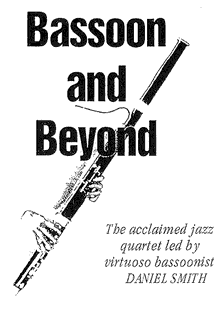
'Bassoon and
Beyond'
as a Jazz Quartet
In working with a jazz piano trio
in order to adapt the bassoon to an all-jazz standards setting, Smith is
extremely comfortable with the concept and the results, even if the instrument
does not treat all of the Jazz Standards equally.
For example, on Thelonious
Monk's “Blue Monk,” the mournful sound of the bassoon is just perfect to
demonstrate how well the concept works.
Jazz and Classical Repertoires
can be mixed subject to Venue Status or Audience preferences.
The
biggest difficulty about promoting this series is getting the publicity out -
it's very time-consuming. We are gradually expanding our communications with the
media and the email list is getting bigger all the time, but the posters do
generate more interest.
It's impossible for us to cover the whole of the Country with our publicity, but
one thing that would really help us would be if you could display the current
posters from this page somewhere useful. A Theatre - Venue - staff-room,
notice-board, village hall - to generate interest. Thank you to anyone who is
able to do this.
Classical & Jazz Programme
For wider audience appeal as a Crossover Performance.
This is a
popular format, especially with established music clubs, they readily
appreciate the classical element but are blown away by the second half Jazz Set
of the evening.
Bassoon with Piano - first half of programme - classical and crossover
selections.
BASSOON & BEYOND jazz quartet after the interval- straight ahead jazz!
For Booking
Enquiries on "Daniel Smith" Jazz Quartet
Contact
E-mail or Phone 01844 353117
E M Fowler
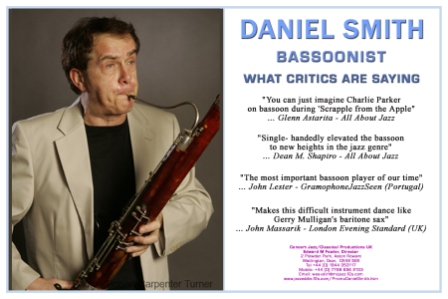
Download This Poster 636Kb
Recordings - Classical
His historic and unprecedented 6 CD set on
ASV of the complete
37 Vivaldi bassoon concertos was chosen as 'Best Concerto Recording
of the Year' by the Music Industry Association and awarded the
Penguin Guide's coveted *** rosette rating as well as inclusion in
Fanfare's annual 'Want List'. These concertos, recorded with The
English Chamber Orchestra and I Solisti di Zagreb, firmly
established Daniel Smith as a leading soloist on his instrument. His
recordings with the Royal Philharmonic Orchestra and Caravaggio
Ensemble for the
ASV White Line label produced innovate crossover
albums, with unique renditions of ragtime pieces, opera excerpts,
and popular standards. In the world of jazz, his albums on the Zah
Zah label, 'BEBOP BASSOON' and 'THE SWINGING BASSOON' showcase the
music of Charlie Parker, Thelonious Monk, Sonny Rollins, Horace
Silver, Duke Ellington, Count Basie, Dizzy Gillespie and many other
legendary jazz artists. Other recordings of Daniel Smith are
available on Vox,
MHS, KemDisc, Pearl,
Spectrum, Cambria, Regis, Crystal and Forum labels.
 His
performances have included many firsts: The American West Coast
premiere of Pulitzer Prize-winning composer Gunther Schuller's
'Concerto for Contrabassoon and Orchestra'; the world premiere of
Steve Gray's 'Jazz Suite For Bassoon' with the Welsh Chamber
Orchestra; solo concerts at New York's Lincoln Centre and the Tivoli
Concert Hall in Copenhagen, and also five appearances at London's
'Pizza On The Park' with his jazz quartet. Other major venues where
he has performed include New York's Carnegie Recital Hall (two
appearances) and the Merkin Concert Hall. In London, the Wigmore
Hall (three times), St.John's Smith Square, and the BBC Concert
Hall.
His
performances have included many firsts: The American West Coast
premiere of Pulitzer Prize-winning composer Gunther Schuller's
'Concerto for Contrabassoon and Orchestra'; the world premiere of
Steve Gray's 'Jazz Suite For Bassoon' with the Welsh Chamber
Orchestra; solo concerts at New York's Lincoln Centre and the Tivoli
Concert Hall in Copenhagen, and also five appearances at London's
'Pizza On The Park' with his jazz quartet. Other major venues where
he has performed include New York's Carnegie Recital Hall (two
appearances) and the Merkin Concert Hall. In London, the Wigmore
Hall (three times), St.John's Smith Square, and the BBC Concert
Hall.
In 2003, Daniel Smith was designated as 'Ambassador for the Bassoon'
by Youth Music in the UK.
In 2005, legendary composer/arranger ROBERT FARNON dedicated his
final composition to Daniel Smith. Entitled 'Romancing the Phoenix',
this three movement bassoon concerto for solo amplified bassoon with
rhythm section and full symphony orchestra in a jazz oriented style
with symphonic overtones was written specifically with Daniel in
mind. Warner Chappell recently published the score and parts with
Robert Farnon's dedication to 'The American virtuoso Daniel Smith'
on the title page. World-wide premieres of this exciting and
innovative piece by one of the 20th Century's greatest
composer/arrangers is listed above.
If you wish to Purchase Copies of any of Daniel Smith's Jazz, Classical or Crossover
CD's -
click here >
Daniel Smith CD Purchase Enquiry
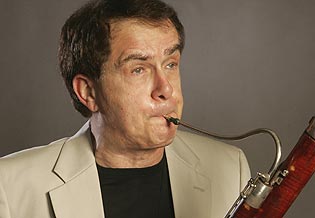
Dan on Jazz Improvisation on the Bassoon
I would like also
to bring up the subject of unusual and different music which can be
performed on the bassoon and also jazz. Ragtime if executed with the
right feeling can sound very natural on the instrument, as does a
large amount of 'crossover' material including transcriptions of
music normally performed on other instruments as well as orchestral
pieces. As for playing jazz on the bassoon several years ago, Steve
Gray composed a work for me entitled 'Jazz Suite' which I had the
honour of performing with the Welsh Chamber Orchestra. The piece
contained improvisational spots and which forced me to plunge in and
get serious about playing real jazz on the instrument. I was already
a virtuoso so to speak but all of my technical skills were of no
help whatsoever in learning how to play jazz in a serious way. I had
to methodically learn to play extended chords and scales from top to
bottom on the instrument and in all keys. This included many scales
and chords which do not appear in classical music. And then to place
all ideas exactly where the underlying chords are heard and of
course to 'hear' musical ideas many measures before you execute
them. This took me about four years to accomplish and along the way
my arms became very sore and stiff from the effort. But then
suddenly the ideas flowed and the soreness stopped... everything
just flowed! All the musical ideas made sense and can now perform a
full two hour jazz concert without using any music and with a
repertoire of nearly one hundred jazz pieces to pick from including
bebop, swing, Latin, blues, ballads, etc.
Finally, the bassoon must be amplified when performing jazz, otherwise it would not be heard above a rhythm section, let along a full symphony orchestra. I have a special microphone attached to my crook/bocal which makes this possible. When Robert Farnon found this out, he was much relieved knowing that his music would be clearly heard above the orchestra in his bassoon concerto, And as for developing a jazz style on the instrument, there are no real role models from the past to learn from such as Armstrong, Gillespie or Davis on trumpet or Parker, Getz or Rollins on saxophone. It is all pioneering stuff and I am very pleased to be involved in such ground breaking efforts and of course with the bassoon concerto of Robert Farnon as a fitting memorial to his memory and talent.


Reviewers Click Here to ask us for CD and Press Kit
Recordings - Jazz
JAZZ SUITE FOR BASSOON
A suite especially written for Daniel Smith by
renowned British composer (and former member of classical/rock group 'Sky')
Steve Gray. Originally written and performed with the Welsh Chamber Orchestra,
this version has been specially arranged for small jazz combo and featured some
of the best British jazz musicians on the UK scene.
 .........Jazz
Suite: Finale
(Gray)
MP3: 164kb
.........Jazz
Suite: Finale
(Gray)
MP3: 164kb
Daniel Smith's latest recordings, BEBOP BASSOON and THE SWINGIN' BASSOON are released on the Zah Zah label. Featuring a top US rhythm section (pianist Martin Bejerano, bassist John Sullivan and drummer Ludwig Afonso), the two CDs were recorded 'back-to-back' and up until now have been only available from Daniel's management where they were enthusiastically received by jazz critics worldwide.
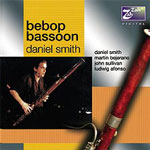 Daniel
Smith has invested a lot of time and energy to bring the repertoire
of the bassoon into ragtime, jazz and contemporary music. Smith has
recorded such titles as Bassoon Bon Bons, Bravo Bassoon
and The Swinging Bassoon, as well as performances of
Gunther
Schuller's “Concerto for Contrabassoon and Orchestra” and
Steve
Gray's “Jazz Suite for Bassoon and Orchestra.” As a result of his
many and diverse bassoon recordings, he has received considerable
media attention for his efforts. In 2005, composter/arranger Robert Farnon dedicated his final composition to Smith:
“Romancing the
Phoenix,” a three-movement bassoon concerto with rhythm section and
symphony orchestra in a jazz setting .
Daniel
Smith has invested a lot of time and energy to bring the repertoire
of the bassoon into ragtime, jazz and contemporary music. Smith has
recorded such titles as Bassoon Bon Bons, Bravo Bassoon
and The Swinging Bassoon, as well as performances of
Gunther
Schuller's “Concerto for Contrabassoon and Orchestra” and
Steve
Gray's “Jazz Suite for Bassoon and Orchestra.” As a result of his
many and diverse bassoon recordings, he has received considerable
media attention for his efforts. In 2005, composter/arranger Robert Farnon dedicated his final composition to Smith:
“Romancing the
Phoenix,” a three-movement bassoon concerto with rhythm section and
symphony orchestra in a jazz setting .
<Track listing:
Killer Joe; Anthropology; Blue
Monk; Sister Sadie; In A Sentimental Mood; All Blues; Doxy; Up
Against the Wall; Birk's Works; Sticky Wicket.
Killer Joe is No.5 in the allaboutjazz Top 200
Downloads
http://www.allaboutjazz.com/php/jazzdownloads_top.php
In working with a jazz piano trio in order to adapt the bassoon to an all-jazz standards setting, Smith is extremely comfortable with the concept and the results, even if the instrument does not treat all of the titles equally. For example, on Thelonious Monk's “Blue Monk,” the mournful sound of the bassoon is just perfect to demonstrate how well the concept works. However, when he tackles Horace Silver's “Sister Sadie,” the funky classic sounds too artificial. The ballad and blues entries, like the Miles Davis “All Blues” or the Ellington piece “In a Sentimental Mood” are sympatico with the use of bassoon as a lead instrument—as is the case with such bebop classics as “Killer Joe,” the Parker/Gillespie tune ”Anthropology” and Sonny Rollins' “Doxy.” In an interesting departure from this format, Daniel Smith provides an experiment in adapting Coltrane's “Up Against the Wall” to fit a piano-less group of bassoon, bass and drums. Otherwise, Smith is well supported by the trio of Martin Bejerano (piano), John Sullivan (bass) and Ludwig Afonso (drums)
THE MUSICIANS
MARTIN BEJERANO: PIANO
Currently member of the Roy Haynes band. Performed with: Russell Malone, James Moody, Ira Sullivan, Marcus Printup and many others. Major jazz festivals including those of Playboy, Montreal, Aspen, Ravinia, Sedona, Big Sur, Lincoln Centre, Bahia, Charlie Parker. Jazz clubs appearances include: Birdland, The Blue Note, Jazz Gallery, Sunset Club (Paris), Jazz Showcase, Dakota. Recordings on various labels.
JOHN SULLIVAN: BASS
Currently member of the Roy Haynes band. Performed with Joe Lovano, Roy Hargrove, Mike Manieri, Louis Hayes, David Sanchez, Bill Stewart. Jazz club venues and festivals include: The Jazz Gallery, Village Vanguard, The Blue Note, The Knitting Factory, Smalls, Lincoln Centre. Recordings on various labels.
LUDWIG AFONSO: DRUMS
One of New York's premier jazz drummers, currently with Spiro Gyra. Featured with Bob Berg, Ira Sullivan, Nestor Torres, Sammy Figueroa, Eddie Rivera, Hector Martianon, Donny McCaslin. Ensembles include CJB Concert Jazz Band and the Bop Brothers. Recordings on various labels.
Playlist
Well You Needn't [Thelonious Monk] Hay Burner [Count Basie/Sammy Nestico] Scrapple from the Apple [Charlie Parker] St. Thomas [Sonny Rollins] I'm Getting Sentimental Over You [Washington/Bassman] Summer Samba [Marcos Valle] Out of Nowhere [Eddie Heyman] Mood Indigo [Duke Ellington] Home At Last [Hank Mobley] I Remember You [Schertzinger/Mercer] A Night In Tunisia [Dizzy Gillespie/Frank Paparelli] Scrapple from the Apple is No.113 in the allaboutjazz Top 200 Downloads and rising.
http://www.allaboutjazz.com/php/jazzdownloads_top.php
Latest Jazz Recording -
Blue Bassoon
Latest Album BLUE BASSOON is now finished!...at least the recording part. Below is the repertoire recorded and the sequence for the 13 blues pieces. Below the sequence is also a short bio of Larry Campbell, Bob Dylan's guitarist. He is 'Special Guest Artist' on the two early blues pieces indicated with an asterisk. His being part of the album will be a very big plus. I will send out more comments in the next days. As for the album itself, it came out even better than I had hoped for and should attract a great deal of attention in the jazz and music worlds. It is light years beyond my other jazz albums and will prove a major help in pulling in engagements once it is heard on the air and sent to presenters and reviewers. I also have a very strong feeling that it will be a major factor in winning awards in the jazz world. In addition, the version of Billie's Bounce includes three choruses of Charlie Parker's own solos.....this too will definitely attract notice!See 'Daniel Smith & The Making Of Blue Bassoon' on YouTube.
BLUE BASSOON
1. Sack O' Woe Julian 'Cannonball' Adderley
2. The Double Up Lee Morgan
3. The Jody Grind Horace Silver
4. Nostalgia in Times Square Charles Mingus
5. Billie's Bounce Charlie Parker
* 6. My Baby's Gone B B King
7. Scotch and Water Joe Zawinul
8. Equinox John Coltrane
* 9. From Four Till Late Robert Johnson
10. Break Out The Blues George Shearing
11. Footprints Wayne Shorter
12. Solid Sonny Rollins
13. Things Ain't What They Used to Be Mercer Ellington
*Tracks featuring - Larry Campbell (guitar) - Larry is a multi-instrumentalist who has been a studio musician, recording music with other artists on their albums, and a respected sideman, performing as a backup musician in clubs and concert venues, since the seventies. He moves freely between rock, blues, country, folk and Celtic, playing guitar, fiddle, mandolin, pedal steel, cittern, dobro and banjo. In 2005, he released his first solo acoustic guitar album called Rooftops.
Blue Bassoon will be released by Summit Records in early 2010.
In January of 2010, Summit Records will release world-wide Daniel Smith's new all-blues album 'Blue Bassoon' Advance reviews of this ground breaking album have called it 'one of the best jazz album releases of the year' as well as describing Daniel Smith as 'Jazz's premiere bassoon soloist'.
Order your copy of Blue Bassoon
If you're not familiar with the bassoon instrument, it's probably because you never hear it as part of a standard jazz combo or ensemble. Daniel Smith makes the bassoon his specialty and though recognized as a premier classical bassoon soloist, Smith now performs his instrument in the world of jazz and has already been tapped as finalist for Player of The Year of Instruments Rare in Jazz by the renowned Jazz Journalist Association. With the release of Blue Bassoon, Smith continues his journey towards making the instrument more acceptable to mainstream jazz audiences. The sound of the bassoon admittedly takes a while to get use to and is often compared to a deep dark male baritone voice. It is essentially a woodwind instrument in the double-reed family playing in the bass or tenor register. Smith uses this unique voice to provide the most challenging and interesting interpretations of standards from a host of jazz and blues legends. This is an album packed with a jazzed up all-blues repertoire. He starts out with Horace Silver's “The Jody Grind,” followed by “The Doub le Up” by Lee Morgan and continues with music from Cannonball Adderley, B.B. King, Charlie Parker, Mingus and Coltrane to name a few.
Smith's bassoon solos lacks the fire of an alto or tenor saxophone but does command your attention much like the sound from the reserved baritone saxophone that will draw you in with its husky charm. There's a lot of swing on this album and you can feel it on Joe Zawinul's “Scotch and Water,” Mercer Ellington's “Things Ain't What They Used To Be,” and Parker's perky “Billie's Bounce.” Let me tell you right off the bat whether you like the bassoon or not, the selection of music here is outstanding.
Helping the bassoon player on this special album are pianist Martin Bejerano, Edward Perez on the bass, Ludwig Alfonso on the drums and guitarist Larry Campbell on “My Baby's Gone “ and “From Four Till Late. Blue Bassoon is not your typical jazz album but then again the bassoon is not your typical jazz instrument. Daniel Smith's contribution on this recording may go a long way to paving the way for acceptance of a sound that may be foreign to most but is warmly nurtured here. Review by Edward Blanco
................The Jody Grind (mp3) ................ My Baby's Gone (mp3) ................ Scotch And Water (mp3) CD Review:
Daniel Smith - Blue Bassoon 5/4
O's Notes: When we first met Dan, a world-class classical bassoonist in Europe in 2005, he was just getting into jazz. He was contemplating the best way to excite jazz fans. We talked about his project Bebop Bassoon and soon afterwards the CD was released. It was pretty good and definitely unique. Smith became an obsessed student of jazz since then and has improved his chops measurably. Now fast forward to January 2010 and the release of his debut on Summit Records; it is cooking! Daniel tames the bassoon extracting, dare we say 'sweet' tone on "Billie's Bounce" while maintaining a blistering pace. He trades blows with pianist Martin Bejerano without missing a beat. Ludwig Alfonso (d) and Edward Perez (b) keep the bottom tight and add some impressive solos as well. We liked "Nostalgia in Times Square", "Equinox" and "Footprints"; all presented in a way you have never heard them before. Special guest Larry Campbell plays guitar on two blues tracks notably "My Baby's Gone". Get ready for something different on this disc. The bassoon is an instrument with a unique sound that feels strange at first but finds a home in jazz space with Blue Bassoon. Daniel Smith is a welcomed new voice. I think he'll be around for a while - a good thing! - D. Oscar Groomes
O's Place Jazz Magazine
http://www.OsPlaceJazz.com
If you wish to Purchase Copies of any of Daniel Smith's Jazz, Classical or Crossover CD's -
click here > Daniel Smith CD Purchase Enquiryand yet another album is now being created...BassooNova
The producer is Brazilian guitarist/composer, Sandro Albert. Sandro will not only produce but also play on the sessions,
Sandro Albert
Reviews -
British Double Reed Society-
2 CDs - 'Bebop Bassoon' and 'The Swingin' Bassoon'
There is not one but two problems with the bassoon playing jazz. The first is obvious and Daniel Smith sums it up neatly in his sleeve note: 'I believe that the main reason for jazz on the bassoon being such a rarity lies in the very nature of the instrument." This, by extension, includes the player: hardly any bassoonist will have originally taken up 'this noble instrument of mirth' (as Anthony McCall Smith calls it) to concentrate on playing serious jazz, whereas a sax player at least has the natural choice of genres. The second problem is the audience. Whether a lover of jazz or not, does the listener want to hear the bassoon's singing tenor register or it's bouncy bass notes employed in this way? Does the bassoon offer a genuinely new star in that galaxy which can deliver sparkle or blues effortlessly such as trumpet, sax, piano, bass or trombone- or cut through the textures of a brass or sax section?
Daniel Smith is clearly someone to be reckoned with. His discography is huge, and his advocacy of the jazz bassoon concept is enormously energetic. In the end it will be personal listener choice that decides whether his enterprise succeeds and, particularly, these CDs sell. Indeed, Smith sounds altogether relaxed and assured in standards by Monk, Parker, Ellington, Mercer, Gillespie and others. Whatever you decide in the end about jazz bassoon, you will certainly admire the accompanying trio whose playing is always sympathetically and flexibly stylish. - Clive Fairbairn
Bassoonist Daniel Smith switch hits from classical to swing to hard bop on this rewarding studio set. Other than some choice solos by pianist Martin Bejerano, the quartet stays in the background, providing support to Smith’s amazingly fluid lines, which shine forth through a set of jazz standards. You can just imagine saxophonist Charlie Parker on bassoon during the band’s take on “Scrapple From The Apple.” Here and throughout, Smith’s spiky phrasings are balanced by brisk runs fortified by lots of pop, zip and seemingly effortless control.
Enhanced by a varied mix of tunes, the album is much more than a novelty excursion. On “Summer Samba,” the leader is well paired by Bejerano’s upper register choruses, the duo's blithe unison passages running atop a delicate samba pulse. Smith’s imaginative and technically impressive performances are complemented by his band-mates’ deft touch and judicious use of dynamics. - Glenn Astarita - allaboutjazzI'll admit something, I was not quite prepared for this album that was called The Swingin' Bassoon (Zah Zah/Guild). Can a bassoon swing, I found myself asking, and would I be surprised to hear one? I was very surprised.
Daniel Smith has a classical background, but knows that if you have the heart and determination, you can make any instrument fit into the jazz mould, especially when in jazz the moulds are destroyed and remade on a regular basis. Jazz has often flirted with classical music and instruments, as musicians have wanted to test the music and their own limits. For the most part those experiments have worked very well, and with Smith it works superbly. Smith's bassoon begins the album, and at first it sounds like a classical recording. It takes about 25 seconds before he and the band break it down, as they do in "I'm Getting Sentimental Over You". Immediately you sense that there's a different dynamic going on, but it works. Smith gets into a groove by playing Monk's "Well You Needn't", and the creativity continues throughout, with creative renditions of songs by Duke Ellington, Dizzy Gillespie, Sonny Rollins, Charlie Parker (you have to hear "Scrapple From The Apple" to believe it), and Hank Mobley. Helping out Smith on the album are Ludwig Afonso (drums), John Sullivan (bass), and Martin Bejerano, who can definitely read all of Smith's mannerisms in the studio and also get to strut their stuff as they back him up. The piano work of Bejerano was very impressive and reminded me a bit of McCoy Tyner. The Swingin' Bassoon sounds like one of those after-hours albums where everyone has gone home and you're in it for the spirit of the jam and the people in the room jamming with you. A bassoon may not be the first instrument one thinks about, but if it's there and a musician can play, bring it on. Smith brings his best to the table and accomplishes his mission by making the unconventional sound like it is part of the norm. John Book
Coming into jazz originally from a classical background, this CD caught my eye right away. I've always leaned toward jazz played on some of those instruments of the symphony which are not regarded as central to jazz expression - violin, French horn, cello, oboe. Well, the bassoon is only a rung down from the oboe, and is probably one of the most difficult wind instruments to play (along with the French horn). This is not the first time the lengthy fellow from the woodwinds has been called upon to swing, but there hasn't been much of that chamber jazz sort of thing lately, so this disc is most welcome as far as I'm concerned. Zah Zah is an Arabic word used to describe something that shines brightly; it can also refer to something very good. This is a new sub-label of the Swiss label Guild and I'm ready to call it very good. Bassoonist Smith allows that the classical performer has to get rid of all preconceived notions about how to play the instrument if one wants to make jazz swing with it. It's probably a similar challenge on the French horn. Smith's quartet is set up just like a typical jazz quartet featuring tenor sax, but the sound is worlds different. The tunes with a bit of the humour that jazz delivers so well seem to come off the best. Monk's Well You Needn't is perfect for the instrument, and will bring a smile to any jazz fan for sure. The arrangement is quite intriguing with a workout for the bassoon not that different from some Vivaldi concerto. (Vivaldi Meets Monk - now there's an interesting idea...Smith recorded all 37 Vivaldi concertos for the ASV label, by the way.) Others tracks in similar lighter vein are Summer Samba, Sonny Rollins' St. Thomas, and Dizzy's A Night in Tunisia, which closes out the 11 tracks. Scrapple from the Apple starts with quite a feat - Smith copying note for note Charlie Parker's own sax solo! Great fun all 'round. - John SunierThe bassoon is primarily relegated to providing background colours within a symphony orchestra, but much like the late Eric Dolphy turned the bass clarinet into a lead instrument in a small group jazz setting, Daniel Smith intends to establish his ungainly woodwind as a jazz instrument. Smith's second CD as a leader for the English label Zah Zah features pianist Martin Bergerano bassist John Sullivan and drummer Ludwig Afonso , who make up a potent rhythm section. Smiths programme is an ambitious one, digging into standards, swing, bop, hard bop and more. The ballads and slower standards work best, allowing Smith to insert more space between notes. But with faster tempi in pieces like "Scrapple From the Apple" work against him, simply because it is hard to for him to articulate when switching from one note to another when they are close together, unlike the bass clarinet, which can better project sound without blurring the distinctiveness of each note. In any case, Smith proves his point that the bassoon has more potential than simply being relegated to providing background colour. ~Ken Dryden, All Music Guide
Bassoon-focused covers of Swing chestnuts may at first seem foolhardy, if ballsy. Yet Smith has already lugged his ax into the studio to record a set of Bop tunes on bassoon, so this is a more snug, if still daring, fit. Aside from an obscure Hank Mobley tune (“Home at Last”) the set list is not that adventurous, with Tommy Dorsey, Johnny Mercer, Duke Ellington, Basie, and Charlie Parker represented by more or less signature tunes. The take on Parker’s “Scrapple in the Apple” deserves props just because the song itself is so damn challenging no matter the instrument. For the most part, though, this is what you might expect: straight-ahead swing arrangements, but with bassoon. Drummer Ludwig Alfonso sure does swing, and John Sullivan on bass anchors the tunes. While at first listen, each song kicks in with the familiar structure of swing with the jarring addition of the bassoon, making each track walk a tight-rope right off the bat: will this really swing, or is this a novelty? Smith’s chops and warm knowledge of these classics does make them swing, and while there is humour in his lines, it does not come unintentionally or as a gimmick. This is a sincere set, if one that takes your ears some time to really dig it. -- Mike Wood (14 August, 2007The main drawback of Jazz Bassoon is that it doesn’t really match the human voice’s expressive potential. The expressive capacities are restricted. Still, Daniel Smith’s “Mood Indigo” is nicely detached and quirky like one of the bassoon one-offs Illinois Jacquet (which bassoonophiles might persuade Prestige records to collect). There’s some perhaps unavoidable suspect pitching with “Home at Last”. (Well done to whoever found this composition and printed due praise of its creator, Hank Mobley.) The solos on bass (bowed) and piano make it apparent why Martin Bejerano and John Sullivan have regular sessions with Roy Haynes. On drums is the admirable Ludwig Afonso. Bejerano and Sullivan set things up nicely for Smith’s entry on “A Night in Tunisia,” and take over most of the number beautifully. The Jazz bassoon does sound less odd after a while. Coming off surprisingly well is Smith version of Thelonious Monk’s “Well, You Needn’t”. (Maybe he’s listened to records of John Coltrane playing Monk.) Smith knows what he’s doing, he’s inside the music (hence nice choices like Sammy Nestico’s “Hay Burner") and if you don’t like what he does, well, blame the bassoon! by Robert R. Calder
Hearing Daniel is much better than reading about him and you can then form your own opinions as to his deserved status as an Internationally Acclaimed Bassoonist..
CADENCE OCTOBER – NOVEMBER – DECEMBER 2007
The introduction of unique instrumentation into the Jazz canon has a long tradition, with the modern age looking to oddballs like, say, Rufus Harley’s bagpipes, Roland Kirk’s stritch or maybe even Toots Thielemans’ harmonica, among others. One instrument prevalent in symphonic settings that has yet to be truly utilized in a Jazz setting is the bassoon. The low-toned, double reed monster has had its adherents in various wind ensembles or present in the hands of such excellent improvised music specialists such as Karen Borca or Michael Rabinowitz, but there is a void within the Bop setting. Enter Daniel Smith, a player with an incredibly diverse range of interests, proficient in Vivaldi’s concertos, modern Classical works and those of the likes of Bird, Monk and Duke.
Smith’s first all Bop standards record, Bebop and Beyond—Swinging Bassoon made Smith look like the JJ Johnson of the bassoon, where Smith made the tricky, muscular Bop dialogue sound simple. Swingin’Bassoon picks up where its predecessor left off, a set of eleven familiar pieces with a strong quartet that includes pianist Martin Bejerano, bassist John Sullivan and drummer Ludwig Afonso.
It is a program of chestnuts, with the fitting opener being the lovely “I’m Getting Sentimental Over You,” a highlight of the interplay being Smith and Bejerano, full of sunny licks and forward momentum. In this vein, the Basie band vehicle, “Hay Burner” takes a ride, while “Mood Indigo” shuffles along at a pleasant gait. Looking at a different perspective, the quartet offers a Latin framework for “Summer Samba” and a Calypso vibe for Sonny Rollins’ “St. Thomas,” the latter offering the spotlight to Afonso’s buoyant, in the pocket rhythms which present style without flash.
The Jazz signposts are all here for the Bop fanatics. Really, how can you pass up Monk’s tricky, “Well, You Needn’t” taken bassoon style? What about the Bop anthems like the sprightly, “Scrapple From The Apple” or “A Night In Tunisia?” Smith and Co. also seek to interpret other classics, such as the lovely “Out Of Nowhere” and “I Remember You,” with the solid supporting case providing plenty of room for Smith to showcase his talents on such a demanding instrument.
Admittedly, hearing these classics within this context is initially a bit of an adjustment. Easily seen as a novelty (or a “legit” player slumming it), Smith makes his case for the bassoon as more than merely an instrument suited for the orchestra or for extra shadings within a Jazz ensemble. Sure, the instrument may take some getting used to with its awkward tonality and rhythmic constraints, but the quality of the material, the tight mainstream ensemble and Smith’s ability to tackle such a demanding instrument (and program) make this a success. Jay Collins

 Visit
the Daniel
Smith
website to sample his CD's or ask us for a promo Copy.
Visit
the Daniel
Smith
website to sample his CD's or ask us for a promo Copy.

Bassoon -
Woodwind Instrument
The beginning of the bassoon is similar to the
oboe.
The bassoon itself first appeared about 1650, and by the end of the
1700’s, it had from 4 to 8 keys.
During the 1800’s, many people experimented
with improving the fingering of the bassoon.
Most of the changes helped the
fingering, but made the tone of the instrument suffer.
The
Heckel
family of Germany managed to improve the fingering of the bassoon
without damaging its tone.
Many professionals today play bassoons made by the Heckel Company.